
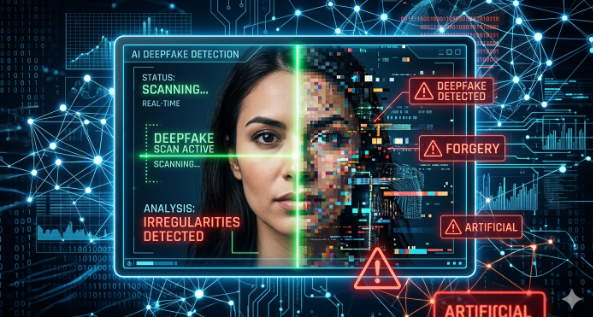
Digital consumption and creation of content has been remodeled with the use of artificial intelligence. The AI technologies have presented new opportunities in creativity and communication, as well as in the production of images by automation, cloning voices, and producing synthetic videos. Nonetheless, similar technologies have also raised great concerns in security. Among the most noticeable dangers of recent years has been the emergence of deepfakes AI-generated videos, pictures, or audio that emulates real individuals with too much horror.
The more convincing and the more accessible deepfakes get, the more organizations, governments, and individuals are resorting to the help of deepfake detection software to discover the manipulated media and ensure digital trust. These tools are very crucial in cybersecurity because they assist in detecting misinformation, preventing fraud, and ensuring that information given on the internet is genuine.
In this article, the authors discuss the meaning of deepfakes and the functionality of deepfake detection software, as well as the reason why this method has become a significant aspect of the current cybersecurity practices.
What Are Deepfakes?
Deepfakes are non-realistic media that are produced by artificial intelligence, albeit by deep learning algorithms. These systems examine substantial amounts of pictures, video or audio records of an individual and subsequently produce new material to resemble their look, voice, or facial expressions.
Initially, deepfake technology was used in matters of entertainment, like the production of realistic visual effects in a movie, or the creation of digital avatars. However, with time, the technology started to be abused with ill intentions such as misinformation campaigns, identity fraud, and impersonation.
A deepfake video may depict a prominent individual uttering statements that he/she has never made. Likewise, a deep fake audio voice can be used to recreate the voice of a person to convince the listeners. With the advancement of these technologies, the line between genuine and faked media is becoming more and more unclear without the aid of special equipment.
The increased menace has resulted in the creation of state-of-the-art deep fake detection applications that can conduct analysis on digital materials and determine whether there are elements of alteration or not.
The reason why Deepfakes are a Cybersecurity issue
Deepfake technology has become accessible to many people, which has raised a number of cybersecurity challenges. The synthetic media can be used to influence the opinion of people, commit financial fraud, or weaken the security of organisations.
Among the most alarming points of deepfakes is the fact that they can be used to disseminate misinformation. Fraudulent videos of political leaders or any other people can be spread quickly in social networks, making people think first and forming a wrong perception. The coordinated disinformation campaigns with deepfakes have been carried out in other instances, aimed at destroying a sense of trust towards institutions.
Deepfakes are also dangerous in businesses. Fraudsters can also commit fraud by using artificial audio to imitate executives over the phone and request employees to move money or reveal confidential data. These attacks may evade the conventional security measures since it is a social engineering technique and not a technical vulnerability.
Moreover, deepfakes may pose a threat to personal privacy and reputation. Photoshopped photos or videos may be utilized to harass or hurt the credibility of an internet user.
Due to these threats, companies are also putting more funding in deepfake detection tools to detect suspicious content and secure their systems against fraud.
Deepfake Detection Software: What It Is?
Deepfake detection software is a specific tool that can be used to analyze digital media and define whether it has been artificially altered or created by an artificial intelligence. The systems rely on sophisticated algorithms that analyze visual, audio, and behavioral patterns which can reflect synthetic content.
In contrast to basic image editing recognition tools, the modern AI-based deepfake detection software is based on machine learning models trained on massive datasets of genuine and manipulated media. Through this, the systems can identify the difference between the real content and fake content because these systems learn differences that cannot be detected by the human eye.
Deepfake technology detection applications have been applied in various industries such as cybersecurity, journalism, digital forensics and social media moderation. Due to the increasing threat of the synthetic media, the best deepfake detection software is increasingly demanded.
The Detection Software of Deepfakes
Deepfake detectors are based on a number of analysis methods in order to detect doctored media. They are methods of analyzing trends in images, videos, and audio to identify deviations that signal artificial creation.
The most popular one is to analyze facial expressions and movements. Face expressions in humans are natural and hard to recreate by the AI models. Blinking frequency, micro-expressions, and movement of the facial muscles are analyzed by detection systems in order to conclude whether a video is real or not.
The other method is centered on artifacts of images. The algorithms of deepfake generation frequently leave minor inconsistencies of light, shadow, or pixel pattern. These irregularities are detected by scanning frames of a video using detection tools.
In certain detection systems, audio analysis is also applied. The voices of AI might include weird frequency patterns or not natural speech patterns. Deepfake detector software is able to examine these features to identify synthetic audio recordings.
Besides analyzing the contents of media in real-time, there are systems which analyze metadata of digital files. The metadata may also provide an insight as to when and how the file was created, which can then assist the investigator in establishing whether the media has been tampered with.
Using these techniques together, AI deepfake detectors software can detect possible forgeries and put content under the review of additional investigations.
The Deepfake Detection and Cybersecurity
The technology of deepfake detection is now a significant element of the cybersecurity strategy. With the increased use of digital communication and remote collaboration by organizations, the threat of synthetic media attacks is only increasing.
A major purpose of deepfake detection software is defense against social engineering attacks on organizations. Through authentication of the authenticity of video or audio communications these systems can be used to ensure that attackers do not impersonate the executives or trusted persons.
One more significant use is digital identity verification. A lot of internet systems use biometric authentication systems like facial recognition. Deepfake detectors can be used to make sure that the individual in a video or photo is a human being, and not an artificial human generated by an artificial intelligence.
Deep fake detection technology also helps the cybersecurity teams to track online places where content is manipulated. In order to avoid spreading misinformation that could tarnish their reputation, organizations can detect fake media in time.
Deepfake detectors are useful in analysing digital forensics practices to determine the authenticity of evidence. The issue of determining whether a video is manipulated or not can be a crucial legal matter or security issue investigation.
Industries with Deepfake Detection Dependence
A number of industries have started implementing deepfake detection software in its security and verification control.
Some of the greatest adopters include financial institutions. Banks and the fintech companies adopt the AI deepfake detection software to prevent identity fraud when creating an online account or during the remote identification verification processes.
The media houses also use the detection tools in establishing the originality of videos and pictures before posting them. This puts more pressure on journalists in ensuring that digital material is authentic particularly in breaking news stories.
Another area of application is social media platforms. These social media sites are exposed to massive amounts of user-generated content and can be prone to misinformation campaigns. The detection systems are used to know the presence of the manipulated media and restrict its distribution.
The deepfake detectors can also be applied in cases of cybercrime, fraud, and threats to national security as well as other areas of investigation conducted by government agencies and law enforcement agencies.
Difficulties in Discovering Deepfakes
Regardless of the advances in technologies of detection, deepfakes are difficult to detect. Deepfakes are becoming more lifelike with better AI models that produce synthetic media and are difficult to identify.
This establishes a perpetuated technology arms race between the makers of deepfakes and makers of detection software. With new generation techniques coming out, detection systems have to be modified accordingly.
The other issue is the accessibility of training information. Detection algorithms need to be trained on massive samples of true and fake media to be trained on the contrasts between them. The process of gathering and tagging such data may be complicated and time-consuming.
There is also the concern with false positives. Detection systems need to have the right tradeoff between accuracy and reliability to prevent false alarms of genuine contents as fake. This equilibrium is a critical element that would keep the society trusting detection technologies.
The Future of Deepfake Detection Technology
It is possible that in the future, the development of deepfake detection software will be based on more sophisticated AI mechanisms that will be able to analyze several layers of digital content at the same time. Such systems could be visual, audio, behavioral, and context analysis to increase accuracy.
Blockchain and digital watermarking technologies are also under discussion as the potential solutions to the media authenticity verifications by researchers. It might be easier to trace the source and integrity of content by including verification information with digital files.
The partnership of technology companies, academic researchers, and government will be essential in dealing with the issues arising because of deepfakes. Establishing international media authentication may be a way to make the digital environment safer.
Meanwhile, the publicity will continue to be a significant element. To decrease the effects of misinformation, it is possible to educate users about the presence of deepfakes and persuade them to critically analyze the content they see online.
Conclusion
Deepfakes may be considered one of the most complicated issues of the digital world today. With the further evolution of artificial intelligence, it will be even easier to produce realistic artificial media. This brings up the issue of misinformation, fraud, and online identity protection with seriousness.
Deepfake detection software is now being a crucial instrument in combating these threats. These technologies are utilized to detect fake content and prevent manipulative actions of the online information by examining digital media to find traces of manipulation.
Financial institutions and media houses to cybersecurity teams and government agencies are among the numerous industries that are currently using AI deepfake detection software to protect their activities. Although difficulties are still present, the effectiveness of detection systems is becoming steadily improved due to the continuous research and innovations in the domain of technology.
The fact that it is now possible to edit digital content with a level of accuracy that has never been seen before makes the quality of authenticity validation more significant than ever. With the ever-evolving technology of deepfakes, deepfake detection software will still be one of the most important elements of cybersecurity and digital trust.