

Many medical organizations still depend on outdated software.
Generic project management tools can track patient outcomes, and spreadsheets can hold clinical trial data, but these systems leave teams creating manual workarounds for everything they cannot handle.
The problem is inefficiency. These gaps affect data quality, compliance, patient care, and staff productivity. Clinical teams can spend hours each week doing work that software can do with automation.
This guide explains what healthcare app development is, what medical organizations are building, which features matter most, and how to approach development without creating expensive problems.
What Is Healthcare App Development?
Healthcare app development means designing and building software for medical, clinical, and healthcare environments.
The scope is broad. A healthcare application can be a patient-facing mobile app, a telemedicine platform, a clinical trial system, or software for hospitals to manage beds, staff, equipment, and resources.
The development approach also differs from standard business software.
A consumer health app tracks steps or calories, while clinical software can store protected health information or support treatment decisions. A software error in a clinical environment has much greater consequences than in a consumer environment.
This distinction affects everything from system architecture and security to testing and maintenance.
How Much Does Healthcare App Development Cost?
Healthcare applications often cost more than standard business software because compliance, security, integrations, and clinical usability need detailed attention from the very beginning.
Several factors influence the final budget.
Compliance requirements can add architecture, documentation, testing, and monitoring work. EHR integrations can increase backend complexity. AI and analytics features require additional development and testing. Clinical UX also needs more research because healthcare professionals often work under time pressure.
Post-launch maintenance adds another ongoing cost. Healthcare software needs security updates, compliance reviews, performance monitoring, and changes as regulations evolve.
A focused clinical application with limited integrations can start around $80,000 to $150,000. Enterprise platforms with extensive EHR integrations, AI capabilities, and compliance requirements can exceed $250,000.
Before estimating the healthcare app cost, define the features you need, integrations, users, and compliance requirements. These factors have the most impact on the final bill.
Types of Healthcare Applications
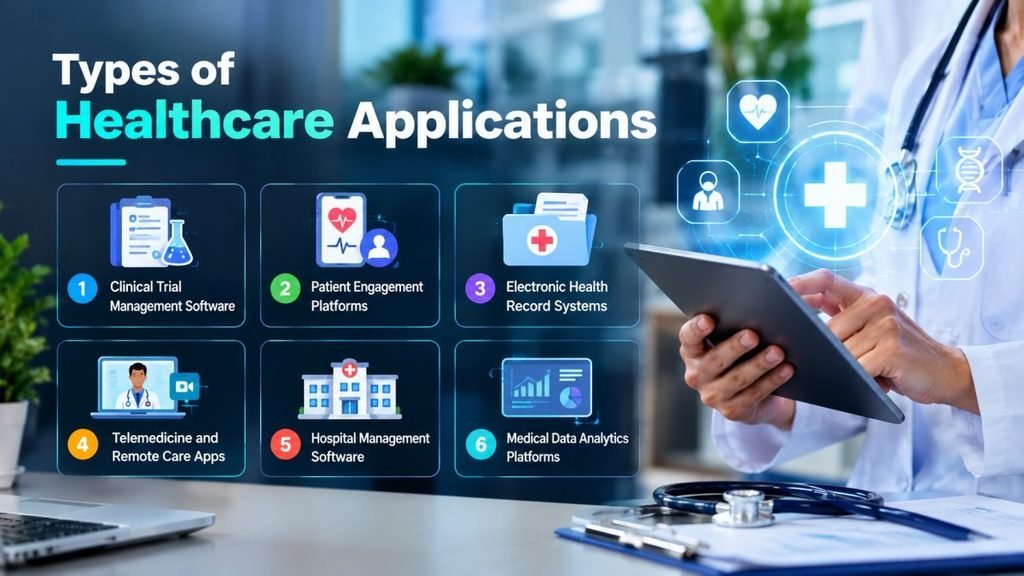
Healthcare organizations need different types of applications based on their clinical and operational needs.
Clinical Trial Management Software
Clinical trial management software helps pharmaceutical companies, medical device organizations, research hospitals, and clinical research teams manage trials across multiple locations.
These systems can support participant data collection, surveys, trial monitoring, reporting, compliance tracking, and data analysis.
The software also needs strong audit capabilities because researchers and regulatory teams may need to review how data enters and moves through the system.
Patient Engagement Platforms
Patient engagement software manages many parts of the patient relationship.
It can support appointment scheduling, reminders, patient portals, secure messaging, follow-ups, and post-discharge communication.
The real value comes from connecting these features with clinical systems.
For example, a scheduling system that does not connect with an EHR can create duplicate work for staff. Patients may also receive outdated information.
A well-designed patient engagement platform connects with the systems already used by the healthcare organization.
Electronic Health Record Systems
Custom EHR development can make sense when existing systems do not support a specific clinical workflow.
Specialty practices, large healthcare networks, and organizations with unique documentation requirements may need more flexibility than standard EHR products provide.
Data architecture becomes especially important here. The system needs to store clinical information in a way that supports sharing, reporting, research, and future integrations.
A poor data model can create major migration and integration problems later.
Telemedicine and Remote Care Apps
Telemedicine applications support video consultations, secure messaging, remote monitoring, and health data collection from connected devices.
The technology itself is no longer the biggest challenge.
Integration is.
A telemedicine platform that stores consultation data separately from the patient’s primary record creates another data silo. Clinicians then need to switch between systems to understand the patient’s complete history.
Good telemedicine software fits into the existing clinical workflow rather than creating another one.
Hospital Management Software
Hospital management systems support the operational side of healthcare.
They can manage beds, staff schedules, equipment, billing, insurance processes, supplies, and other resources.
Hospitals operate around the clock across multiple departments. Each department can have different processes and requirements.
Healthcare-specific software needs to reflect that complexity instead of forcing hospitals to adapt their workflows to generic business software.
Medical Data Analytics Platforms
Healthcare analytics platforms turn clinical and operational data into useful insights.
Predictive analytics can help identify patients who may face higher risks. Operational analytics can help hospitals identify delays, resource problems, and areas where processes need improvement.
AI can also support diagnosis and clinical decision-making by analyzing patient information alongside medical knowledge and guidelines.
These systems support clinicians rather than replacing their judgment.
Features Every Healthcare App Needs
Compliance and Regulatory Controls
Healthcare software needs to address the regulations that apply to its users, location, and purpose.
In the United States, applications handling Protected Health Information may need to meet HIPAA requirements. Applications handling European patient data need to address GDPR requirements.
Some applications may also fall under Software as a Medical Device regulations when they influence diagnosis, treatment, or other clinical decisions.
Compliance needs to shape the architecture from the beginning.
Access controls, encryption, audit logs, secure communication, and data management policies should not become last-minute additions.
Audit trails are particularly important. Healthcare systems need to record important actions such as access to patient records, changes to clinical information, and other activities that affect sensitive data.
Security Architecture
Healthcare data requires strong security because it contains highly sensitive information.
Role-based access control limits what each user can see and change. A billing employee does not need access to clinical notes. A clinician may not need access to detailed financial records.
Encryption protects data during transmission and while stored. Multi-factor authentication adds another layer of protection for staff accounts.
Backup and disaster recovery also matter. A security incident or system failure should not bring essential clinical operations to a halt.
Healthcare System Integration
Healthcare applications rarely work alone.
They often need to exchange information with EHRs, laboratory systems, imaging platforms, pharmacy systems, billing systems, and other applications.
HL7 and FHIR help healthcare systems exchange data. Older environments often rely heavily on HL7, while FHIR provides a more modern API-based approach to interoperability.
Integration planning should happen before development begins.
If the application cannot communicate reliably with the systems around it, even a well-designed product can become difficult to use.
Clinical User Experience
Healthcare UX needs to reflect how clinicians actually work.
Doctors, nurses, administrators, and other healthcare professionals often work under pressure. A process that takes five unnecessary clicks can become a significant problem when staff repeat it hundreds of times.
That is why clinical users should participate in the design process.
The development team needs to understand real workflows before designing screens and features. Testing should also happen with actual users in realistic situations.
Good healthcare UX does not simply look clean. It helps people complete important tasks with less confusion and fewer unnecessary steps.
The Healthcare App Development Process
Discovery
Many expensive development mistakes start before development even begins.
Organizations sometimes move directly into design and coding without understanding the existing workflow. They then discover important gaps during testing or after launch.
A proper discovery phase maps current processes, identifies users, defines compliance requirements, documents integrations, and establishes the data model.
This gives the development team a clear foundation before building begins.
Right Technology
Technology decisions should support the application’s security, reliability, scalability, and integration requirements.
Cloud platforms such as AWS, Azure, and Google Cloud provide infrastructure designed for regulated workloads.
Database architecture also deserves careful planning. Healthcare applications can handle large amounts of structured and unstructured data, and the database needs to support performance, reporting, integrations, and future growth.
Changing these decisions after launch can become expensive.
Build and Test
Agile development can work well for healthcare applications when teams treat compliance and clinical requirements as part of development.
Security testing needs to cover the risks associated with healthcare data. Penetration testing should focus on the actual application and its integrations.
Performance testing also needs realistic data volumes.
An application that performs well with 100 patient records may behave very differently when it handles 100,000.
Clinical users should also test the software throughout development instead of waiting for the final stage.
Launch
Deploying new software in a healthcare environment can affect established workflows.
A phased rollout can reduce that risk. Organizations can start with one department, location, or user group before expanding.
This gives teams time to collect feedback, fix problems, and improve training before wider adoption.
Post-launch work continues as well. Teams need to monitor security, compliance, performance, integrations, and user feedback.
Healthcare software is never truly finished after deployment.
How to Choose a Healthcare App Development Partner
Choosing the right development partner requires more than just portfolio review.
Look for Healthcare Experience
Ask whether the development company has worked on healthcare applications similar to yours.
Experience with patient-facing apps is different from experience with clinical systems, EHR integrations, clinical research platforms, or hospital management software.
Ask how the team handles healthcare compliance during development. Compliance should influence architecture and development decisions rather than appear as a final checklist.
Check Integration Experience
Ask about experience with the EHR and healthcare systems used by your organization.
Integration experience can vary significantly between platforms and environments.
A development partner should understand how healthcare data moves between systems and how to handle older systems that do not support modern APIs.
Understand the Development Process
Find out how the team handles clinical user testing, security testing, compliance requirements, documentation, and post-launch support.
You also need clear terms around intellectual property and source code ownership.
Healthcare organizations should know exactly what they own and how they can access or modify the software after launch.
That is why you need a partner who has already done the heavy lifting in this space. For instance, CMARIX has years of hands-on experience building EHR integrations, telemedicine apps, remote monitoring tools, and clinical trial systems. Because they already understand the complex world of healthcare compliance and data structures, they catch and fix potential roadblocks early on.
Conclusion
Healthcare app development must align with real clinical workflows while securing data, connecting systems, and meeting regulations.
Careful planning prevents most of the expensive post-launch failures. The ultimate goal is not just building another tool, but creating custom software that genuinely fits how medical professionals work.
FAQs
How much does it cost to develop a healthcare app?
The cost depends on features, integrations, compliance requirements, users, and technologies. A focused healthcare application can start around $80,000, while complex enterprise platforms can cost $250,000 or more.
How long does healthcare app development take?
A focused MVP can take four to six months, while complex healthcare platforms with multiple integrations and compliance requirements can take nine to eighteen months.
What regulations apply to healthcare applications?
HIPAA can apply to US healthcare applications handling Protected Health Information, while GDPR applies to personal health data covered by EU requirements. Some clinical applications may also fall under medical device regulations.
Can a custom healthcare app integrate with an EHR?
Yes. Healthcare applications can integrate with EHRs through standards such as HL7 and FHIR, as well as custom integration methods for older systems.
What makes healthcare app development different from normal software development?
Healthcare applications need to address clinical workflows, sensitive patient data, security, interoperability, compliance, and reliability. These requirements influence the entire development process.